Why Men Recover From Pornography Addiction in Groups, Not Alone
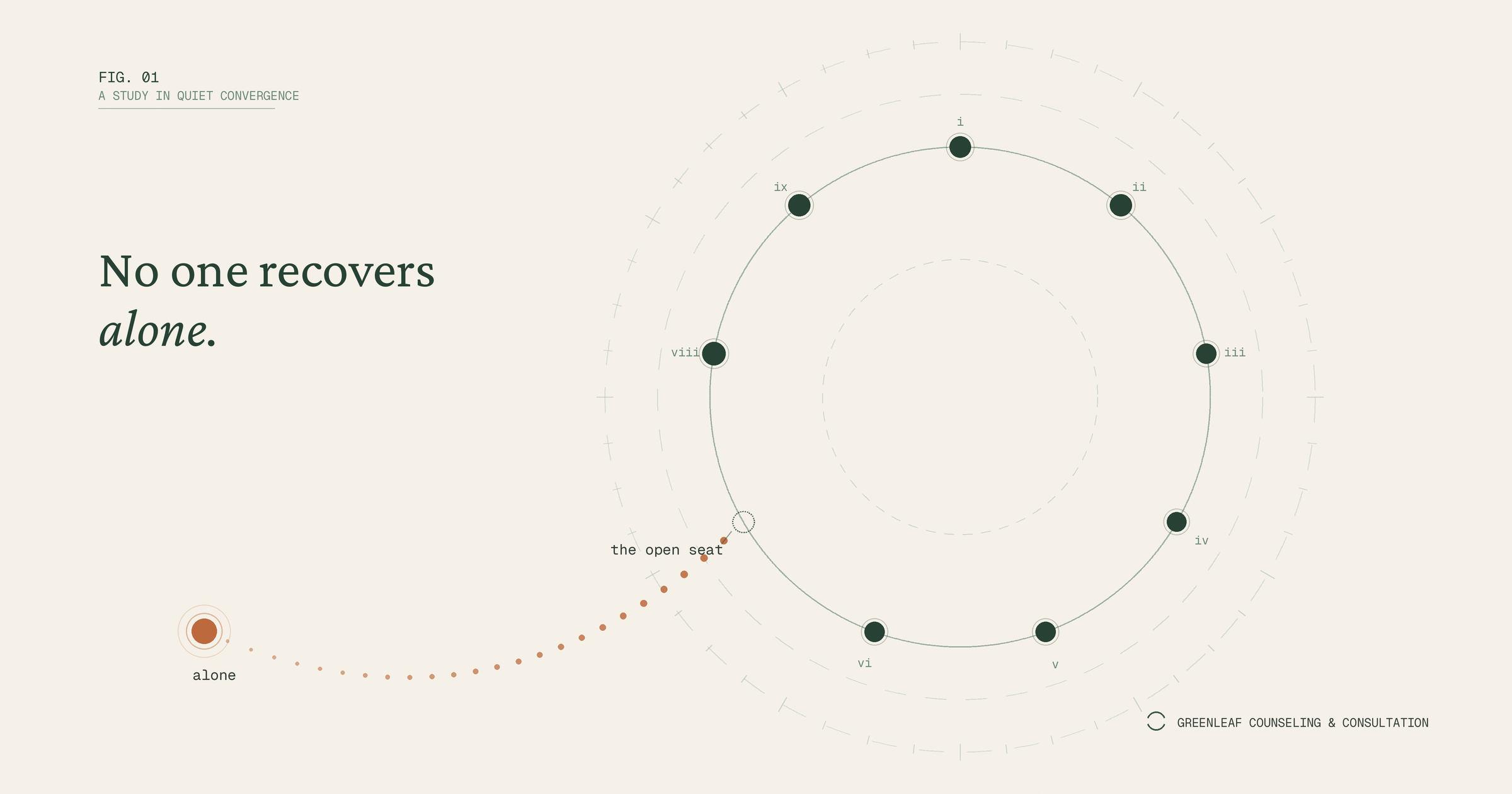
Most men try to quit pornography the same way: alone, in secret, through willpower. They delete the apps, install a filter, and make a promise. It holds for a week or a month. Then a stressful Tuesday arrives, and the cycle starts again.
The problem isn't a lack of effort. It's the strategy. Pornography addiction grows in isolation, and isolation is exactly what the solo approach preserves. That's why group work, whether a therapy group, a 12-step fellowship, or a structured recovery community, is often the turning point for men who have failed on their own for years.
Carnes: shame is the engine, and shame can't be treated in private
Dr. Patrick Carnes, whose research in Out of the Shadows established sex addiction as a treatable condition, found that addicts operate from a set of core beliefs: I am basically a bad, unworthy person. No one would love me as I really am. If I have to depend on others, my needs will never be met. Sex is my most important need.
Notice what those beliefs have in common. Every one of them is a belief about relationships, and every one of them keeps a man hidden. The addiction and the hiding feed each other. He acts out, feels shame, withdraws further from real connection, and then reaches for pornography to medicate the loneliness the withdrawal created.
Carnes described this as a cycle: preoccupation, ritual, acting out, despair, and back to preoccupation. Willpower attacks only one stage of the cycle, the acting out. It leaves the despair and the isolation untouched, which is why white-knuckling fails so predictably.
A group interrupts the cycle at its root. When a man says the unspeakable thing out loud and the room doesn't flinch, the core belief "no one would love me as I really am" takes a direct hit. No amount of private journaling can do that. The belief is relational, so the correction has to be relational too. This is why Carnes built fellowship and accountability into his task-centered recovery model rather than treating them as optional extras.
Weiss: pornography addiction is an intimacy disorder
Robert Weiss, who trained under Carnes and wrote Sex Addiction 101, pushes the point further. In his framing, compulsive pornography use isn't primarily about sex. It's an intimacy disorder. Men who struggle with it typically learned early, often through childhood trauma or neglect, that people are unreliable and vulnerability is dangerous. Pornography offers what feels like connection with none of the risk: no rejection, no demands, no one to disappoint.
If the disorder is a fear of real intimacy, the treatment has to be practice at real intimacy. Weiss argues that group therapy is where this practice happens. A recovery group is a low-stakes laboratory for the exact skills the addiction has atrophied: telling the truth about how you feel, tolerating being seen, staying in the room when someone gives you hard feedback, letting other men matter to you.
Individual therapy is valuable, and for men with significant trauma histories it's usually necessary. But one-on-one work with a therapist can't fully replicate what happens when a man sits with six other men who know his story. Peers can say things a therapist can't. When a man three years into recovery tells a newcomer "I told myself that same lie," it lands differently than any clinical observation.
The Freedom Fight: no one quits porn alone
The Freedom Fight, a faith-based recovery ministry founded by Ted Shimer, has built its entire program around this principle. Their tagline states it plainly: no one quits porn alone. Their model identifies six roots of pornography addiction, and it's striking how many are relational. Isolation is answered with authentic accountability. Negative emotions are answered by processing them with God and with others. Shame is answered by living out of a secure identity rather than a hidden one.
Their program pairs a structured curriculum with accountability groups and daily check-ins, and they report that 86% of participants who complete the program and commit to its core habits find freedom from pornography. Whatever you make of any single statistic, the design choice is telling: a ministry that has worked with thousands of men concluded that content alone doesn't produce change. Community does.
For men of faith, this framing also resolves a common trap. Many Christian men treat pornography as a purely spiritual problem to be solved through private prayer and repeated resolve, which quietly recreates the isolation that drives the addiction. The Freedom Fight's approach, echoing James 5:16, insists that confession happens to people, not just to God. Healing follows the confession that has a witness.
Biblical counselors: change happens in the body of Christ
The biblical counseling movement approaches this struggle from a different starting point than Carnes or Weiss. Biblical counselors are generally cautious about the addiction and disease framing altogether. In their view, compulsive pornography use is best understood as enslaving sin rooted in the desires of the heart, and the counselor's job is to minister Scripture to those desires, not just manage behavior. Heath Lambert, one of the movement's leading voices, makes this case in Finally Free: Fighting for Purity with the Power of Grace, probably the most widely used biblical counseling book on the subject.
You might expect that framework to produce a lone-wolf spirituality. It does the opposite. Lambert names accountability as one of his core gospel strategies and is blunt about how most men do it wrong: they choose an accountability partner who is easy to hide from, confess only after the fact, and confess vaguely. Real accountability, in his telling, involves people who know you, ask before you fall rather than after, and press for the whole truth. Proverbs 28:13 sits underneath the whole approach: the one who conceals his transgressions will not prosper, but the one who confesses and forsakes them finds mercy.
The movement's larger conviction matters here too. Biblical counseling was founded on the belief that God's Word is sufficient and that ordinary believers can be equipped to counsel one another. Change, on this view, is not a private project between a man and his willpower, or even a man and his counselor. It happens inside the local church, through the dozens of "one another" commands of the New Testament: confess to one another, bear one another's burdens, encourage one another daily so that none is hardened by sin's deceitfulness (Hebrews 3:13). A men's discipleship group working through pornography together isn't a supplement to biblical change. It's the normal biblical context for it.
There's a genuine tension between the biblical counseling model and the clinical addiction model, and it's worth being honest about it. One says sin, the other says addiction; one centers the sufficiency of Scripture, the other draws on neuroscience and trauma research. But look at what both prescribe in practice and the overlap is hard to miss: secrecy broken, sin or symptoms confessed to real people, honest questions asked regularly, and a community that keeps showing up. Whatever a man's theological starting point, the prescription converges on the same room full of chairs.
What group work actually does
Pull the threads together, from the clinical researchers to the ministries to the biblical counselors, and a consistent picture emerges. Groups work because they:
Break secrecy. The addiction requires a double life. A group makes the double life impossible to maintain, because someone is asking how the week actually went.
Dismantle shame through exposure, not exhortation. Shame shrinks when a man is known and accepted anyway. It cannot be reasoned away in private.
Provide accountability with warmth. Accountability without relationship becomes surveillance, and men rebel against surveillance. Accountability inside genuine friendship is something men will actually keep showing up for.
Teach intimacy by rehearsal. Every group meeting is a repetition of the skill the addiction replaced: connecting with real people who can't be clicked away.
Offer hope with evidence attached. A man who has relapsed for fifteen years needs to sit across from someone who relapsed for twenty and is now three years free. Hope transfers person to person.
Getting started
If you're a man in this fight, the practical first step is smaller than you think: tell one safe person the truth. A therapist, a pastor, a trusted friend. From there, the options widen. Twelve-step fellowships like Sex Addicts Anonymous meet in most cities and online. The Freedom Fight offers a free 30-day challenge and certified online groups. Many churches run men's groups using Finally Free or similar material, and a trained biblical counselor can walk alongside a man within his own church community. Therapist-led groups, especially those run by a Certified Sex Addiction Therapist (CSAT) trained in the Carnes model, add clinical depth for men whose pornography use is tangled with trauma, depression, or marital crisis.
The common denominator isn't the format. It's the decision to stop fighting alone.
Frequently asked questions
Does group therapy work for pornography addiction? Yes. Because compulsive pornography use thrives on secrecy and isolation, groups treat the condition at its root in a way solo willpower can't. Clinical researchers like Patrick Carnes and Robert Weiss, faith-based programs like The Freedom Fight, and biblical counselors all build recovery around confession, accountability, and community.
What kinds of recovery groups are available? The main options are 12-step fellowships such as Sex Addicts Anonymous, structured faith-based programs like The Freedom Fight, church-based men's groups, and therapist-led groups run by a Certified Sex Addiction Therapist (CSAT). Many men combine a group with individual counseling.
Do I need individual therapy too, or is a group enough? It depends on what's underneath the behavior. For many men, a group is the backbone of recovery, but if pornography use is tangled with trauma, depression, anxiety, or a marriage in crisis, individual work with a CSAT or counselor alongside the group usually produces better outcomes.
Is pornography addiction a sin problem or a clinical problem? Clinicians describe it as an addiction and intimacy disorder; biblical counselors describe it as an enslaving sin of the heart. In practice, both frameworks prescribe the same first steps: end the secrecy, confess to real people, and get into a community that asks honest questions.
Ray Brandon is a Certified Sex Addiction Therapist (CSAT) at Greenleaf Counseling and Consultation Professionals LLC in Kalamazoo, Michigan, serving men across Southwest Michigan in person and throughout Michigan via telehealth. If you're ready to talk with someone about compulsive pornography use, reach out to schedule a consultation.
