Better Conversations, Better Connection: How Couples Counseling Rebuilds Intimacy, In and Out of the Bedroom
Most couples don't come to counseling because they've stopped loving each other. They come because they've stopped reaching each other. The conversations that used to flow now stall or spark. The easy affection has thinned out. And somewhere along the way, the sexual connection that once felt natural started feeling complicated, infrequent, or gone.
The encouraging news comes from four decades of research: communication is a skill, and couples learn it in counseling every week. And because emotional and sexual connections run on the same wiring, when conversations improve, the bedroom usually follows.
How communication breakdown becomes connection breakdown
Dr. John Gottman spent his career watching real couples argue in his research lab, and in The Marriage Clinic, he lays out what he found: it's rarely the topic of the conflict that damages a relationship. It's the way the conflict is handled. Four patterns in particular, which he calls the Four Horsemen, predict relational decline with unsettling accuracy: criticism, contempt, defensiveness, and stonewalling.
Watch what these patterns do over time. A wife raises a concern with a harsh startup ("You never help with anything"), her husband gets defensive, she escalates, and he shuts down. Nothing gets resolved, so the same fight returns next month with more heat. Each round teaches both partners that raising something honest is dangerous. So they stop raising things. They talk about logistics and kids and stay away from anything tender.
That's the connection breakdown. And sexual connection is one of its first casualties, because sex is the most vulnerable conversation a couple has, even when no one is speaking. It's hard to be naked with someone you've learned to guard yourself around. When couples tell us "we've lost our physical connection," the trail almost always leads back to conversations that stopped feeling safe long before the bedroom went quiet.
Trust is built in small moments, not grand gestures
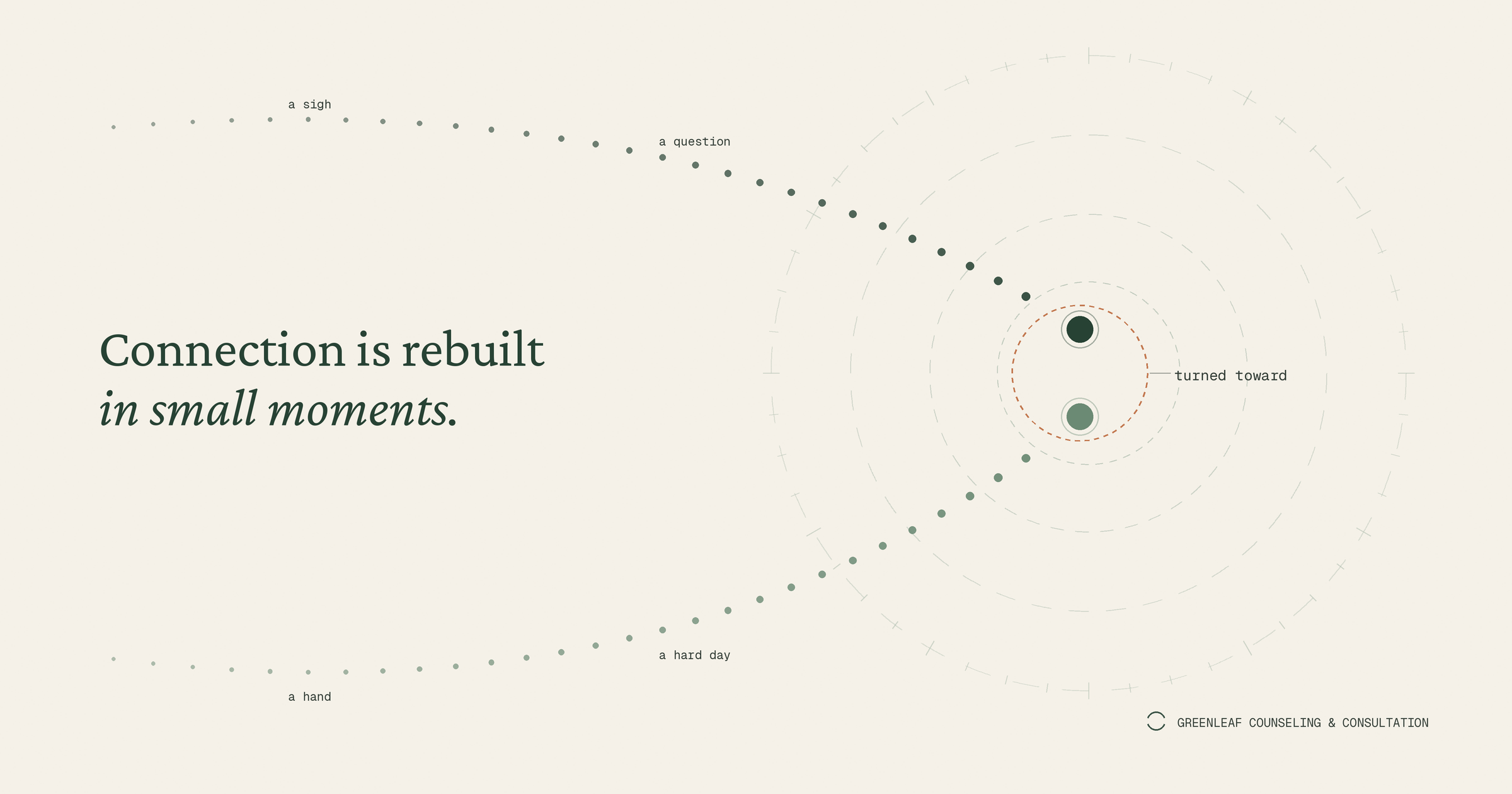
The same lab that mapped how connection erodes also mapped how it gets rebuilt. In The Science of Trust, Gottman's answer turns out to be smaller and more hopeful than most couples expect. He describes "sliding door moments": the dozens of tiny bids for attention a partner makes every day. A sigh from the kitchen. A comment about a hard meeting. A hand reaching across the couch. In every one of those moments, you either turn toward your partner or away from them.
Couples who turn toward each other's bids consistently build what Gottman calls an emotional bank account, and that account is what makes both conflict and sex go better. His research found that emotionally attuned couples fight more gently, repair faster, and report more satisfying sex lives. Attunement even has an anatomy in his model: awareness of your partner's emotion, turning toward it, tolerating it without fixing or fleeing, seeking to understand it, responding non-defensively, and offering empathy.
For a discouraged couple, this is the most practical finding in the book. Connection gets rebuilt in Tuesday-night moments, one turn-toward at a time, and Tuesday nights are available to every couple this week. No grand gesture required.
The sex you want starts with a conversation you haven't had
Attunement also opens the door to the conversation most couples have been avoiding the longest: the one about sex itself. Dr. Tammy Nelson's Getting the Sex You Want picks up exactly there, with a blunt observation about where couples get stuck: they've never actually told each other what they want. Asking feels risky, so they don't. What if I'm judged? What if I hurt their feelings? What if the answer is no? So each partner guesses, the guesses drift out of date, and both people quietly conclude the other has lost interest.
Nelson's answer is structured dialogue. Borrowing from Imago therapy, she teaches couples to talk about sex in a format where one partner speaks and the other mirrors back what they heard, validates it, and responds with empathy before saying anything of their own. The structure sounds mechanical until you try it. What it actually does is make the scariest conversation in the relationship safe enough to have. She has couples start with appreciations ("Something I love about our sex life is...") before ever getting to requests, so the conversation opens with warmth instead of a grievance list.
Her deeper point aligns with Gottman's research from the other direction: desire doesn't die with age or familiarity nearly as often as it dies from silence. Couples who learn to talk about sex with curiosity instead of criticism routinely discover that the passion wasn't gone. It was waiting for permission to speak.
How we work with couples at Greenleaf
All three of these threads, Gottman's conflict research, his trust research, and Nelson's work on desire, shape how we practice. At Greenleaf Counseling and Consultation, we don't ask couples to figure out where to start. We begin with a Gottman relationship assessment, a formal evaluation that maps your relationship's specific strengths and friction points: how you handle conflict, how you make bids and respond to them, where trust has worn thin, and how each of you experiences your emotional and sexual connection.
From there, we draw on approaches matched to what the assessment reveals. Gottman Method Couples Therapy, built on the Sound Relationship House model, strengthens friendship, deepens fondness and admiration, and teaches concrete skills for managing conflict, including softened startups and repair attempts. Emotionally Focused Therapy helps couples get underneath the recurring fight to the attachment needs driving it, so the argument about the dishes can finally be recognized as the question it always was: "Are you there for me?" We also incorporate focused marital therapy and, where sexual connection is the presenting concern, guided intimacy dialogues in the spirit of Nelson's work, so couples leave sessions with conversations they can actually have at home.
The sequence matters. We work on safety and communication first, because a sexual connection rebuilt on a shaky emotional foundation doesn't hold. But couples are often surprised by how quickly the two move together. When contempt leaves the arguments and turning-toward returns to the ordinary moments, warmth comes back into the bedroom sooner than most people expect.
An encouraging word
If your relationship feels distant right now, take this seriously: the research is on your side. Gottman's lab found that what separates couples who thrive from couples who drift is a set of learnable behaviors, not compatibility, chemistry, or how rarely they fight. Turning toward bids. Starting complaints gently. Repairing after a blowup. Saying out loud what you want, including in bed.
You don't have to become different people to do any of that. You need practice in a room where practicing is safe. That's what couples counseling is for.
Frequently asked questions
Can couples counseling really improve our sex life? Yes, and usually by working on communication first. Research from John Gottman's lab shows that emotionally attuned couples report more satisfying sex lives, and Tammy Nelson's clinical work shows that guided conversations about desire reignite intimacy. Most sexual disconnection is a communication and trust problem, expressing itself physically.
What is a Gottman assessment? It's a structured evaluation, including questionnaires and interviews, that maps a couple's strengths and problem areas across the dimensions Gottman's research identified: friendship, conflict style, trust, shared meaning, and intimacy. It gives counseling a specific starting point instead of a guess.
How long before we notice a difference? It varies by couple, but the skills involved are concrete, and many couples report calmer conflict and warmer daily interactions within the first several sessions. Rebuilding trust and sexual connection takes longer, and the early gains are what make that deeper work possible.
Do we have to talk about sex in front of a counselor? Only at a pace you choose. Part of the counselor's job is to make that conversation safer than it has ever been at home, often through a guided dialogue in which each partner is fully heard before the other responds. Most couples find it far less awkward than they feared, and many say it was the conversation that changed things.
Ray Brandon is a Certified Sex Addiction Therapist (CSAT) at Greenleaf Counseling and Consultation Professionals in Kalamazoo, Michigan, providing couples counseling in person for Southwest Michigan and via telehealth across Michigan. If you and your partner are ready to rebuild communication and connection, reach out to schedule a consultation.
